





THE MOON AND ITS EFFECTS ON WINE
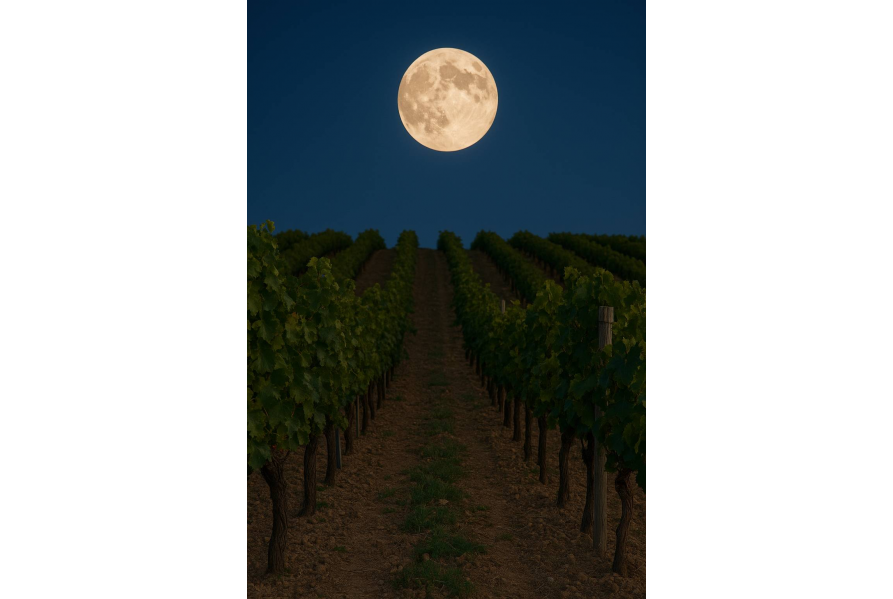
THE MOON AND ITS EFFECTS ON WINE
Much has been said, and continues to be said, about how the moon affects liquids. There are many urban legends, romantic tales, popular beliefs — and also a scientific basis.
The moon, our only satellite, has exerted its influence, magnetism, and power of seduction since the beginning of time over all generations that have inhabited our blue planet.
Its power and influence have always been subjects of speculation, its attraction used for Saint John’s Eve spells, mythical transformations, hidden wishes of love… Legends and stories that coexist with the scientific certainty of the influence it exerts on us — on the tides, on liquids… on wine.
According to the agricultural lunar calendar, the moon affects liquids in a way similar to how it affects the tides.
When we have a full or new moon, the gravitational pull between the Earth, the Sun, and the Moon aligns and increases the movement of liquids. This is manifested in higher tides, more active sap in plants, and livelier fermentations.
Activity — Recommended Lunar Phase — Reason
Racking (transfers)
? Waning quarter
The wine is more stable; sediments settle.
Bottling
? Waning quarter or “fruit” day
Lower risk of cloudiness.
Fermentations or pump-overs
? Waxing quarter
Lively activity; favorable aeration.
Wine tasting
“Fruit” or “flower” days
Better aromatic and flavor expression.
Cleaning or resting
? Full moon or ? New moon (avoid handling)
Liquids are “under tension.”
These guidelines form the basis of biodynamic viticulture, which we’ll discuss another time. We can give them as much credibility as we wish — we’re simply presenting what popular belief, supported by science, has accepted as true and reliable: the influence of the moon on liquids.
We’ll delve deeper into the topic…
When the moon is in its waxing or waning quarter, that influence diminishes: the liquids settle, there is less internal movement, and stability is favored.
If we follow popular belief regarding the moon’s influence on wine, we can establish that:
-
FULL MOON AND NEW MOON: the wine is more lively and nervous; it’s not advisable to move it, rack it, or bottle it. Any movement could cloud the wine or disturb its balance.
-
WANING QUARTER: this is the ideal time for racking, clarification, and bottling, as sediments settle and the wine stabilizes.
-
WAXING QUARTER: with greater microbiological activity, this is the best time for fermentation or aeration.
Even for tastings, it’s recommended to do them during the waning quarter, when the wine is calmer and more balanced.
Here’s a summary of some of the cellar tasks according to the lunar phases:
Activity — Recommended Lunar Phase — Reason
Racking (transfers)
? Waning quarter
The wine is more stable; sediments settle.
Bottling
? Waning quarter or “fruit” day
Lower risk of cloudiness.
Fermentations or pump-overs
? Waxing quarter
Lively activity; favorable aeration.
Wine tasting
“Fruit” or “flower” days
Better aromatic and flavor expression.
Cleaning or resting
? Full moon or ? New moon (avoid handling)
Liquids are “under tension.”
These guidelines form the basis of biodynamic viticulture, which we’ll discuss another time. We can give them as much credibility as we wish — we’re simply presenting what popular belief, supported by science, has accepted as true and reliable: the influence of the moon on liquids.
We’ll explore the topic further…